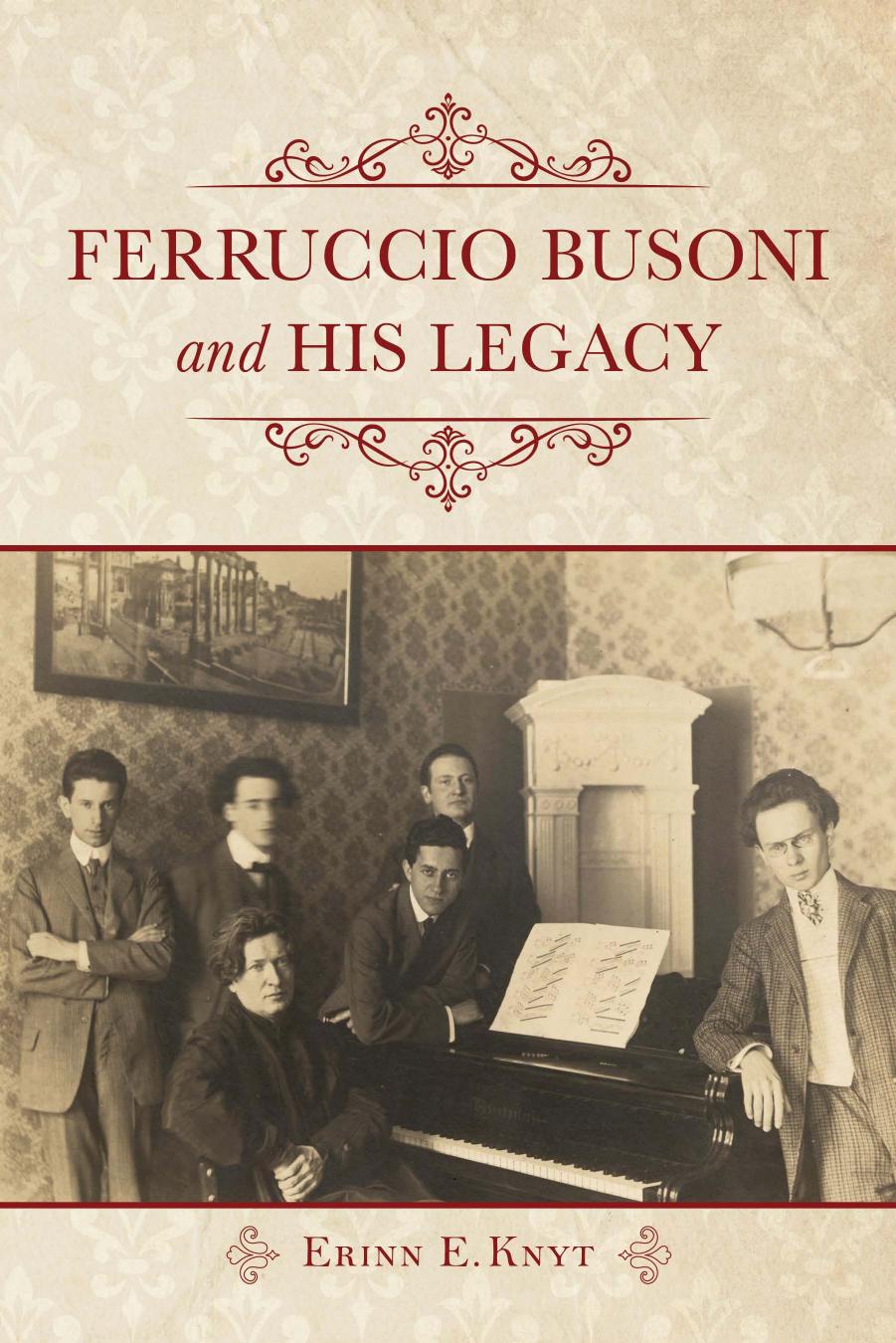
Ferruccio Busoni and His Legacy by Erinn E. Knyt
Author:Erinn E. Knyt
Language: eng
Format: epub, pdf
Publisher: Indiana University Press
MUSIC EXAMPLE 5.1. Luening, “Requiescat,” W. 25, mm. 1–4.
Luening received a solid foundation in performance, theoretical and historical subjects, and composition at the Zurich Conservatory. He states that his aim there “was to learn everything [he] possibly could, in breadth if not in depth.”5 He not only studied his main instrument, the flute, but also took lessons on other orchestral and percussion instruments just to gain a better understanding of how they worked. Jarnach, who was then Busoni’s personal secretary and also a professor at the Zurich Conservatory, provided Luening with a theoretical foundation. In particular, Luening remembers Jarnach’s advice about analysis: “As an analysis teacher, he [Jarnach] restricted himself to note-by-note, rhythm-by-rhythm study of the preludes and fugues of the first volume of The Well-Tempered Clavier. The harmonic and contrapuntal movement was studied in detail until the overall form became clear. The net result of this workout was that I really learned how to read and analyze a composition carefully and to study every note in any composition.”6
Jarnach also taught a course in score playing that started with four-part choral works in old clefs and progressed to string quartets and symphonies. During private lessons with Jarnach, which consisted of daily afternoon discussions of works in progress, Luening was expected regularly to bring canons, part of an invention, or a fugal exposition.7 Luening also remembers discussing his Sonata for Violin and Piano no. 1, W. 26, the Sextet, W. 32, the String Quartet no. 1, W. 38, numerous songs, and other chamber pieces.8 What Jarnach communicated, above all else, was the importance of high craftsmanship.9
After studying with Jarnach, Luening began to earn a reputation as a promising young traditionalist composer. When his Sonata for Violin and Piano no. 1, W. 26, and a few songs were performed publicly in Zurich, reviews were full of praise: “Thoroughly modern feeling was peculiar to songs by Otto Luening, ‘Mysterium’ and ‘At Christmas’; his forceful idiom was rewarded by vigorous applause. The most important work on the program was the same composer’s sonata for violin and piano. The first two movements showed decidedly personal traits and a fine mastery of modern form while the Fugato-Finale showed an admirably developed technical proficiency.”10
STUDYING WITH BUSONI
Yet while Jarnach provided a solid technical foundation, Busoni provided imaginative stimulation and aesthetic ideas that transformed Luening’s compositional approach, leading it in new and innovative directions. Luening first consulted Busoni about his compositions in 1919 at the suggestion of Jarnach, even if he had already witnessed and had been entranced by Busoni’s performances and compositions beginning in 1917. In particular, Luening remembers being present at the premiere of Busoni’s Arlecchino, BV 270, and Turandot, BV 273, on May 11, 1917, at the Zurich Stadttheater, a performance that impressed him so much he claims he “came under Busoni’s spell.”11 The music was lighter, briefer, and more transparent than the German music he had previously encountered in Munich. The stylistic contrasts, ranging from Mozartian ensembles to instrumental dances to exotic orientalisms, were striking.12
Download
Ferruccio Busoni and His Legacy by Erinn E. Knyt.pdf
This site does not store any files on its server. We only index and link to content provided by other sites. Please contact the content providers to delete copyright contents if any and email us, we'll remove relevant links or contents immediately.
The Goal (Off-Campus #4) by Elle Kennedy(13786)
Kathy Andrews Collection by Kathy Andrews(11982)
Diary of a Player by Brad Paisley(7653)
Assassin’s Fate by Robin Hobb(6300)
What Does This Button Do? by Bruce Dickinson(6264)
Big Little Lies by Liane Moriarty(5883)
Altered Sensations by David Pantalony(5157)
Pale Blue Dot by Carl Sagan(5083)
Sticky Fingers by Joe Hagan(4257)
The Death of the Heart by Elizabeth Bowen(3680)
The Heroin Diaries by Nikki Sixx(3614)
Confessions of a Video Vixen by Karrine Steffans(3353)
Beneath These Shadows by Meghan March(3345)
How Music Works by David Byrne(3331)
Computational Linguistics and Intelligent Text Processing: 20th International Conference, CICLing 2019 La Rochelle, France, April 7â13, 2019 Revised Selected Papers, Part I by Alexander Gelbukh(3247)
The Help by Kathryn Stockett(3194)
Jam by Jam (epub)(3158)
Harry Potter 4 - Harry Potter and The Goblet of Fire by J.K.Rowling(3135)
Strange Fascination: David Bowie: The Definitive Story by David Buckley(2913)
